
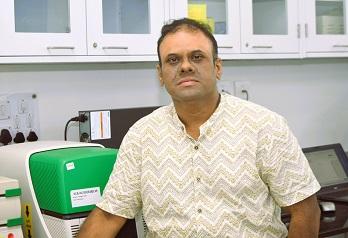
Sourish Ghosh,
Senior Scientist
Infectious Diseases and Immunology
Research Focus
Decoding the Hidden Language of Viruses Our laboratory is interested in understanding how viruses manipulate host cellular machinery to survive, replicate, and spread. We explore the emerging world of intracellular organelles and extracellular vesicle (EV)-mediated communication that viruses exploit for non-lytic release, immune evasion, and intercellular transmission. Using interdisciplinary approaches spanning virology, cell biology, imaging, and molecular biology, we aim to uncover fundamental mechanisms of host–virus interactions and identify novel antiviral therapeutic targets against emerging and neurotropic viruses.
Research Interest
Lipid Droplets: Beyond Fat Storage — Viral Escape Platforms
A major focus of our research is the role of lipid droplets (LDs) in the life cycle of Japanese Encephalitis Virus (JEV). Our group was among the first to discover the functional interplay between lipid droplets and small extracellular vesicles (sEVs) in facilitating non-lytic release of JEV. We are currently investigating the molecular checkpoints regulating LD biogenesis, LD–lysosome interactions, and EV-mediated viral egress. In parallel, we are screening small molecules capable of disrupting LD formation and associated trafficking pathways to block viral release and spread. This work aims to reveal entirely new antiviral intervention strategies targeting host organelle dynamics.
Extracellular Vesicles and Rotavirus: Hijacking Cellular Communication
Our laboratory also investigates how Rotavirus utilizes extracellular vesicles as carriers of viral and host-derived regulatory molecules. We are particularly interested in miRNAs co-transported within large EVs and how these small RNAs silence specific host pathways to create a cellular environment favorable for viral replication. By understanding EV-mediated host modulation, we aim to uncover previously unrecognized mechanisms of viral persistence and pathogenesis.
Mother–Neonate Viral Interactions and Mucosal Immunity
An exciting area of our research focuses on mother–neonate interactions during Rotavirus infection. We have identified mammary alveolar epithelial cells as a potential site of viral replication and are exploring how infection alters epithelial plasticity and induces stemness-associated pathways. In addition, we study how Rotavirus infection modulates mucosal immunity, including the non-specific enhancement of secretory IgA (sIgA), and the molecular mechanisms underlying these responses. These studies may provide important insights into neonatal immunity, viral transmission, and maternal protection.
Credentials
- Principal Scientist, Infectious Diseases & Immunology, CSIR- Indian Institute of Chemical Biology (2026-present).
- Senior Scientist, Infectious Diseases & Immunology, CSIR- Indian Institute of Chemical Biology (2022-2026).
- Research Fellow, National Heart, Lung and Blood Institute (NHLBI), National Institutes of Health, Bethesda, USA (2021-2022).
- Research Scholar, National Heart, Lung and Blood Institute (NHLBI), National Institutes of Health, Bethesda, USA (2016-2021).
PhD, National Brain Research Centre, Manesar (2010-2016)
- Fellow / Membership-
- American Society of Virology (2017-present).
- Indian Society for Extracellular Vesicles (2026-present)
Honours & Awards
- DBT/Wellcome Trust India Alliance Intermediate Fellowship (2024-2029)
- Ramalingaswami Re-entry Fellowship, DBT-India, 2021.
- ASV 2019 Postdoctoral Travel Award American Society for Virology (2019).
- Summer Mentor Award Office of Intramural Training & Education, National Institutes of Health (2019).
- Visiting Fellow fellowship from 2016-2021, National Institutes of Health (2016).
- DBT Travel Award, Department of Biotechnology, India (2015).
Fellow / Membership-
- American Society of Virology (2017-present).
- Faculty 1000, Associate (2015-present).
Grants & Supports
- Tuning Lipid Droplets for Antiviral Interventions in Brain, Role: Principal Investigator, Funding Agency: Department of Biotechnology, Tenure: 2024-2027, Grant Number: BT/PR51484/MED/122/359/2024, Grand Award Amount: 0.8 Cr (INR)
- Role of Mother-Neonate Dyad Interaction in resolving Pediatric Viral Infection, Role: Principal Investigator, Funding Agency: DBT/ India Alliance, Tenure: 2024-2029, Grant Number: IA/I/23/2/506972, Grant Award Amount: 3.54 Cr (INR)
- Role of small non-coding RNAs sorted inside Extracellular Vesicles for RNA Virus Persistence, Role: Principal Investigator, Funding Agency: DST-SERB, Tenure: 2024-2027, Grant Number: CRG/2023/004359, Grant Award Amount: 0.45 Cr (INR)
- Vesicular Transmission of Flavivirus & Its role in Neurodegeneration, Role: Principal Investigator, Funding Agency: CSIR-Focused Basic Research (FBR), Tenure: 2024-2026, Grant Number: FBR070305, Grand Award Amount: 0.69 Cr (INR)
Patents & Publications
Selected Publications:
- Mallick B, Mondal A, Sarkar A, Chakraborty T, Khan K, Kumar D, Biswas SC, Ghosh S. Lipid droplets and small extracellular vesicles interplay in Japanese encephalitis virus non-lytic release. mBio. 2026
- Kelvin AA, Baker PH, Ghosh S, Schultz-Cherry S, Langel SN. Influenza infection of the mammary gland. J Virol. 2025
- Sarkar A, Ghosh S¥. SARS-CoV-2 persistence: A potential catalyst for age-associated neurodegenerative diseases. Advanced Neurology. 2024. (Cover Page)
- Mondal S, Ghosh S. Liposome-Mediated Anti-Viral Drug Delivery Across Blood-Brain Barrier: Can Lipid Droplet Target Be Game Changers? Cell Mol Neurobiol (2023)
- Ghosh S, Kumar M, Santiana M, Zhang M, Mishra A, Chibly AM, Nakamura H, Tanaka T, Chiorini JA, Hoffman P., Altan-Bonnet N. Enteric viruses replicate in salivary glands and infect through saliva. Nature (2022).
- Ghosh S, Dellibovi-Ragheb T, Pak E, Fisher M, Hsu V, Bleck C, Takvorian P, Fehr A, Perlman S, Altan-Bonnet G, Altan-Bonnet N. b-Coronaviruses Use Lysosomes for Egress Instead of the Biosynthetic Secretory Pathway. Cell (2020).
- Roth AN, Helm EW, Kirsche E, Smith JC, Mirabelli C, Eurell LB, Ghosh S, Kennedy E, Hernandez A, Baldridge MT, Altan-Bonnet N, Wobus CE, Karst SE. A Novel Mouse Model of Norovirus Diarrhea. Nature Communications (2020).
- Santiana M., Ghosh S. (equal contribution), Ho B. A., Rajasekaran V., Wen-Li Du W. L., Mutsafi Y., De Je´ sus-Diaz D. A., Sosnovtsev S. V., Levenson E. A., Parra G. I., Takvorian P. M., Cali A., Bleck C., Vlasova A. N., Saif L., Patton J. T., Lopalco P., Corcelli,Green K.Y., and Altan-Bonnet N., Vesicle-Cloaked Virus Clusters Are Optimal Units for Inter-organismal Viral Transmission. Cell Host & Microbe (2018).
- Ghosh S, Mukherjee S, Basu A. Chandipura virus perturbs cholesterol homeostasis leading to neuronal apoptosis. J Neurochem. (2015).
- Ghosh S, Dutta K, Basu A. Chandipura virus induces neuronal death through Fas-mediated extrinsic apoptotic pathway. J Virology. (2013).
For a complete list of publication please visit:
https://scholar.google.com/citations?user=QYDLZ1AAAAAJ&hl=en&oi=ao